DiverseVAR: Balancing Diversity and Quality of Next-Scale Visual Autoregressive Models

ECCV 2026

TL;DR

DiverseVAR makes text-conditioned visual autoregressive models produce different outputs for the same prompt, with no retraining and little extra compute. Noise on the text embedding creates the variation, and scale-travel repairs the image quality that the noise costs.

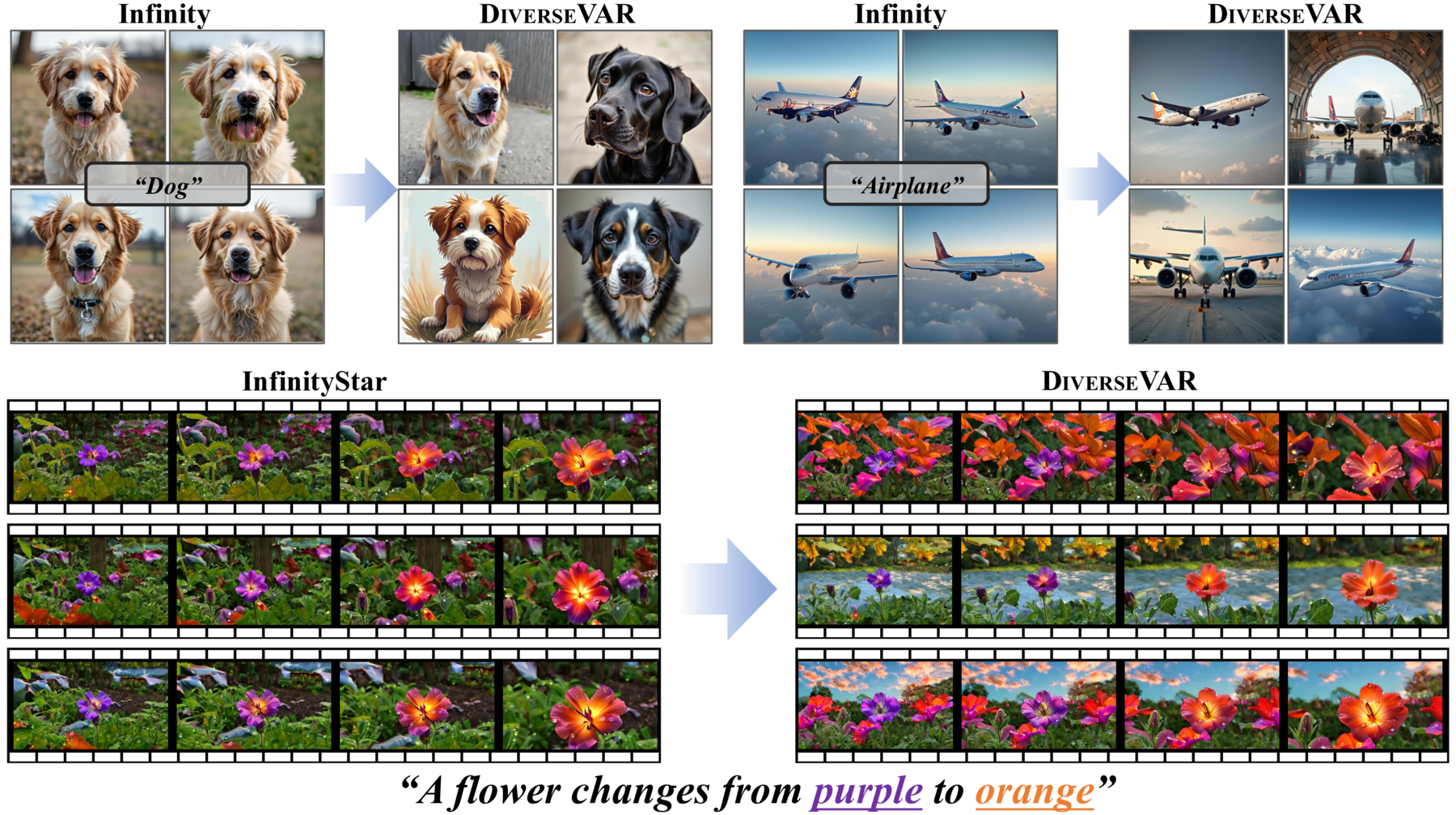
DiverseVAR teaser comparison
Infinity and InfinityStar return nearly the same output for one prompt no matter which seed we use. DiverseVAR pulls the samples apart and then cleans up what the perturbation broke.

Abstract

We introduce DiverseVAR, a test-time framework that enhances the output diversity of text-conditioned visual autoregressive models (VAR) without additional training or substantial computational overhead. While VAR models have recently emerged as strong competitors of diffusion and flow models for image and video generation, they suffer from a critical diversity limitation: even simple prompts often produce nearly identical outputs.

We address this limitation in two stages. First, we systematically explore diversity enhancement techniques by injecting noise into different components of VAR at test time, finding that noise injection into the text embedding yields the best diversity gains. However, this comes at the cost of sharp degradation in image quality. To recover quality, we propose scale-travel: a latent refinement technique that leverages a multi-scale autoencoder to extract coarse-scale tokens and resume generation from intermediate stages.

Extensive experiments demonstrate that combining text-embedding noise injection with scale-travel refinement substantially improves diversity while minimizing quality degradation, advancing the diversity-quality Pareto front.

2-Stage Pipeline

DiverseVAR runs in two stages. The first weakens the text condition early in generation so that different seeds stop converging on the same image. The second sends the resulting sample back through the multi-scale representation that VAR already uses, and regenerates its finer scales.

1

Condition Annealing

Start with weak conditioning and gradually strengthen it across scales.

Where the noise goes: (a) CFG scheduling mixes the conditional and unconditional logits, (b) condition annealing perturbs the <SOS> token or the text embedding.
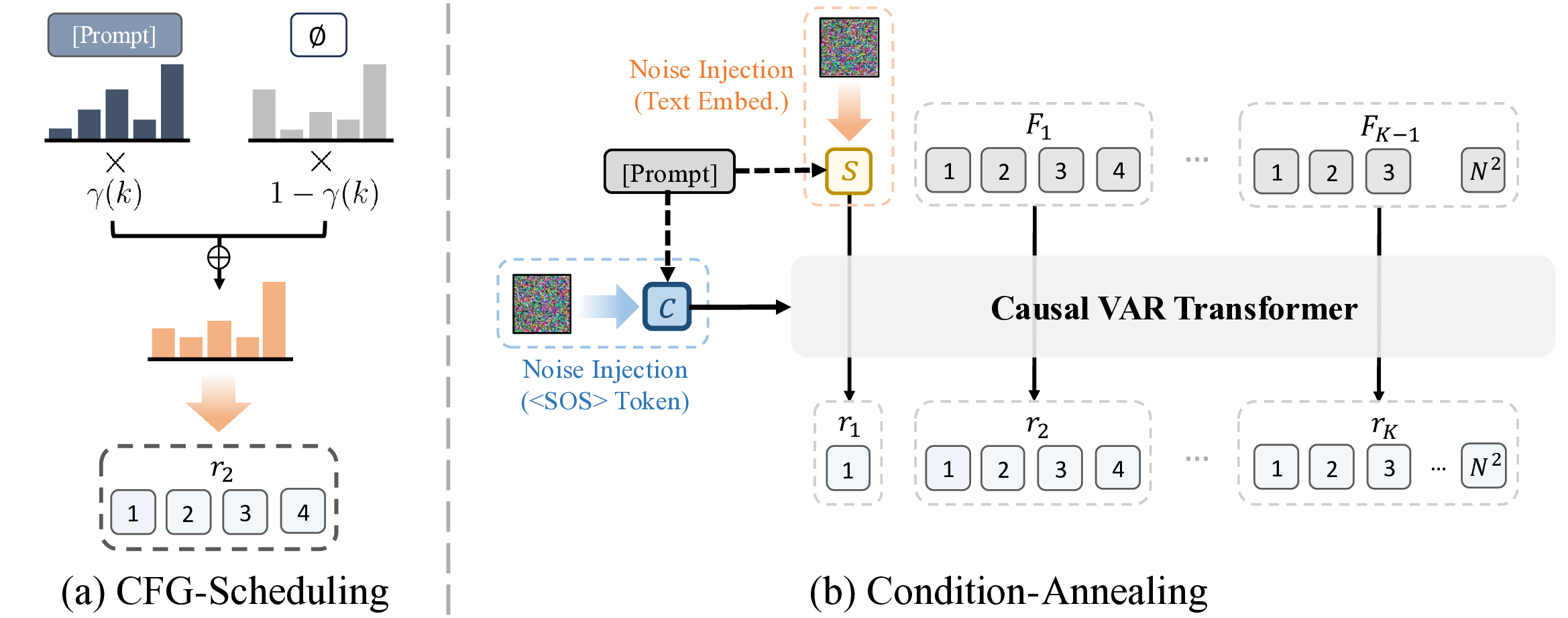
CFG scheduling and condition annealing for visual autoregressive models
2

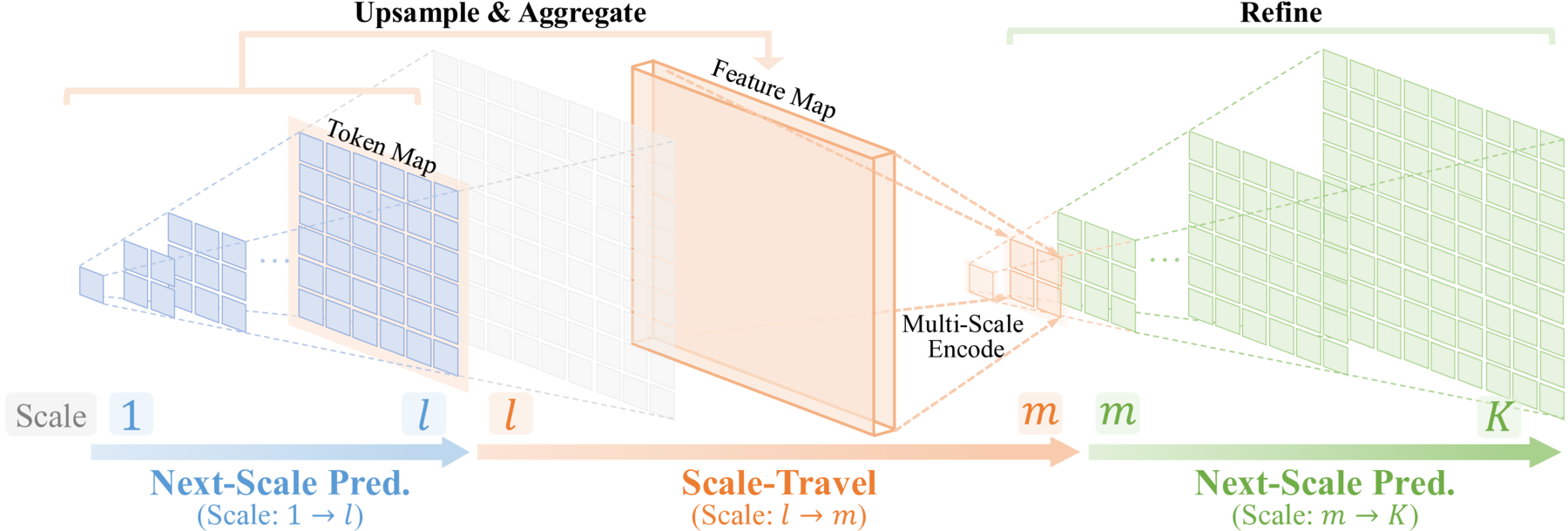
Scale-Travel

Travel back to an earlier stage and regenerate to refine visual artifacts.

(+) Refines visual artifacts with a slight diversity drop. (−) Adds only 20% inference overhead.

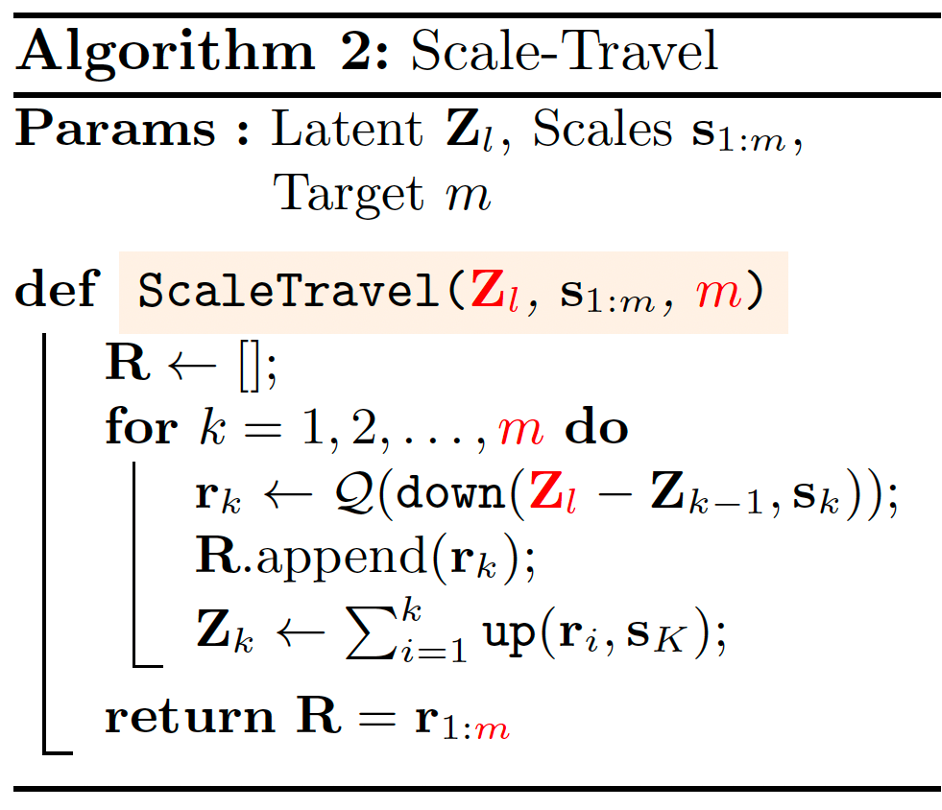
Run next-scale prediction to scale l, upsample and aggregate the token maps into a feature map, re-encode it at scale m, then predict on to K.
Scale-travel refinement pipeline
The scale-travel step itself, which is VAR's multi-scale encoding with the loop stopped at m instead of K.
Algorithm 2, Scale-Travel pseudocode

Inference time

Seconds per image on an RTX 3090, batch size 1, averaged over 100 samples.

Method Time Slower
Infinity 2.115s
+ Cond. Anneal. 2.266s ×1.07
+ Scale-Travel 2.638s ×1.24
Switti 1.642s
+ Cond. Anneal. 1.692s ×1.03
+ Scale-Travel 1.892s ×1.15

Results

We evaluate DiverseVAR on Infinity and Switti for text-to-image generation and on InfinityStar for text-to-video generation, using MJHQ-30K and MS-COCO prompts. More samples are on the qualitatives page.

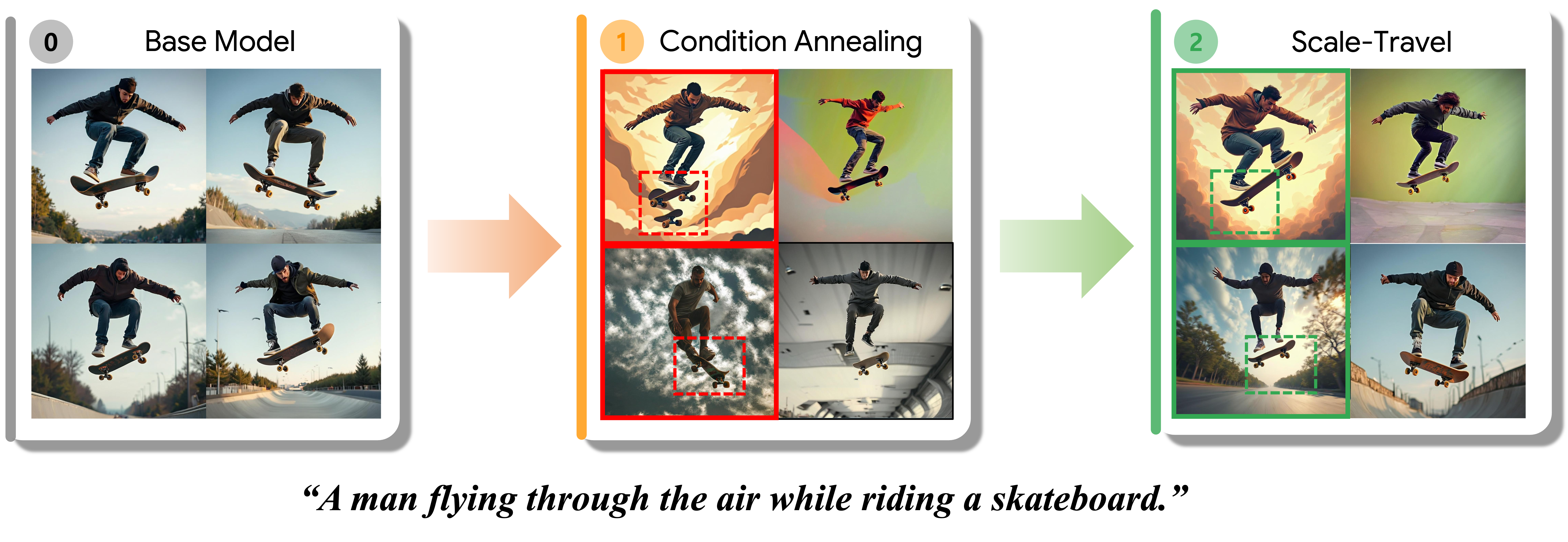
Base model, condition annealing, and scale-travel samples for one skateboard prompt
One prompt through both stages of DiverseVAR. Infinity repeats a single composition, condition annealing breaks that repetition but damages the boards marked in red, and scale-travel repairs those regions without pulling the samples back together.
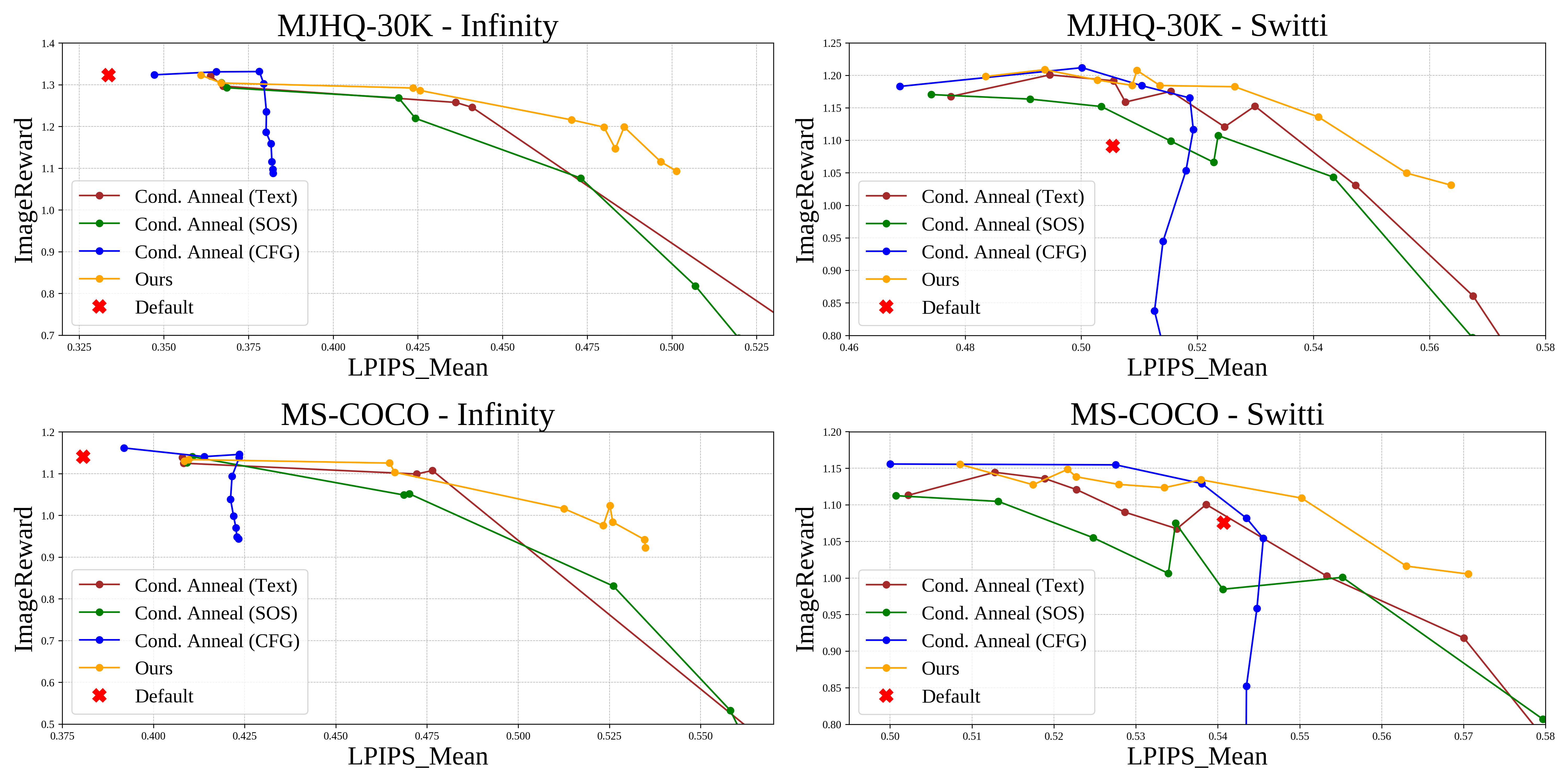
Pareto fronts for diversity-quality trade-off
ImageReward against mean LPIPS on MJHQ-30K and MS-COCO. At equal diversity our curve sits above the condition-annealing curves, and it keeps climbing where they fall off.

Quantitative comparisons

Text-to-image on MJHQ-30K and MS-COCO. FID and ImageReward (IR) measure quality, MPDL and Vendi measure per-prompt diversity.

Method MJHQ-30K MS-COCO
FID ↓ IR ↑ MPDL Vendi ↑ FID ↓ IR ↑ MPDL Vendi ↑
Infinity 19.16 1.22 0.33 4.10 37.37 1.16 0.37 4.41
+ Cond. Anneal. 15.53 0.49 0.56 7.68 22.51 0.39 0.58 8.13
+ Scale-Travel (Ours) 15.28 1.08 0.48 6.07 28.97 1.04 0.52 6.68
Switti 16.18 1.11 0.44 4.79 25.92 1.18 0.46 5.32
+ Cond. Anneal. 21.34 0.63 0.58 7.34 25.26 0.78 0.59 7.74
+ Scale-Travel (Ours) 17.30 0.93 0.56 6.68 23.47 1.05 0.57 7.22

Text-to-video on InfinityStar-8B, generated from VBench-2.0 prompts and scored with VBench. Condition annealing gains more diversity (+132.2%) but loses quality. Scale-travel raises diversity from 0.270 to 0.487 (+80.4%) and gives up 0.002 points of quality.

Method Diversity ↑ Quality Score ↑
InfinityStar 0.270 0.806
+ Cond. Anneal. 0.627 0.794
+ Scale-Travel (Ours) 0.487 0.804

Citation

@inproceedings{park2026diversevar,
  title     = {DiverseVAR: Balancing Diversity and Quality of Next-Scale Visual Autoregressive Models},
  author    = {Park, Mingue and Phunyaphibarn, Prin and Lee, Phillip Y. and Sung, Minhyuk},
  booktitle = {European Conference on Computer Vision},
  year      = {2026}
}